Title
![]()
CVD Case Fatality in Barbados
BNR CVD case-fatality briefing, 2023
Barbados National Registry | The University of the West Indies
Updated on 06 May 2026
Key messages
Women | Stroke
29%
age-adjusted case fatality, 2022-2023
Men | Stroke
30%
age-adjusted case fatality, 2022-2023
Women | Heart attack
16%
age-adjusted case fatality, 2022-2023
Men | Heart attack
14%
age-adjusted case fatality, 2022-2023
Before age adjustment, women had higher case fatality than men for both conditions. Age explained part - but not all - of this gap.
Why case fatality matters
Case-fatality rates show what happens after patients reach hospital care.
- They describe the short-term consequences of cardiovascular events.
- They complement case counts and incidence rates.
- They help identify whether outcomes differ by event type, sex, and age.
Case fatality is not a measure of population risk. It is a measure of survival among people who had a hospital-registered event.
What we did
We reviewed hospital-registered stroke and heart attack events in Barbados and summarised case fatality by event type, sex, and age profile.
- We used two-year periods to stabilise the estimates.
- We compared crude, unadjusted modelled, and age-adjusted modelled probabilities.
- We examined whether the higher case fatality observed among women was explained by age.
Higher case fatality in women after heart attack and stroke
Main pattern
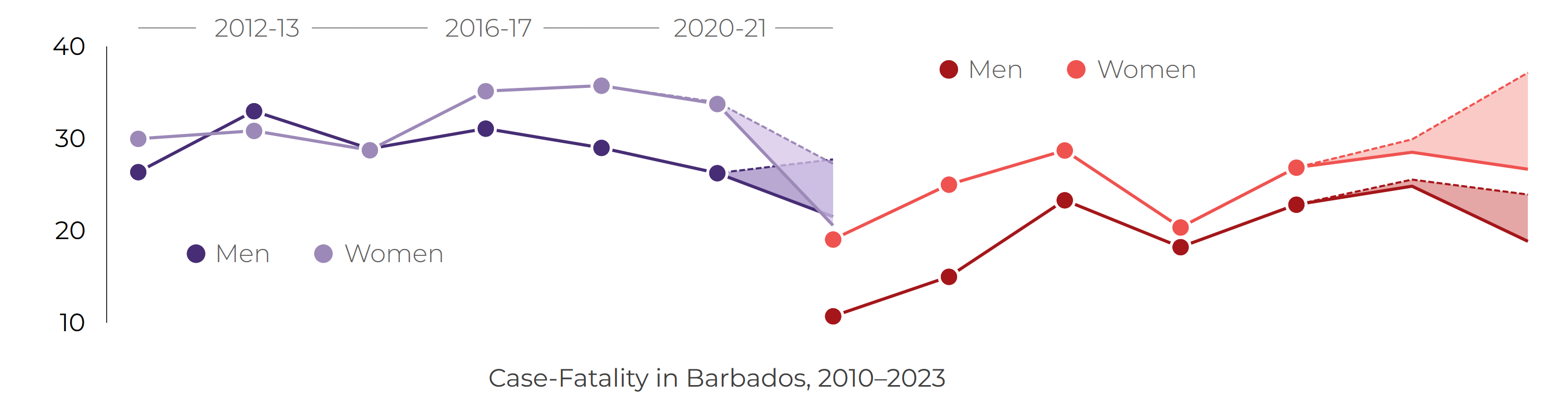
- Stroke case fatality changed little over time.
- Heart attack case fatality fluctuated and showed some evidence of an upward trend.
- Before age adjustment, women had higher case fatality than men for both conditions.
Interpretation
Women admitted with heart attack or stroke were, on average, older than men.
The older age profile among women explained part of the female excess in case fatality, but did not remove it completely.
This means the observed difference should be interpreted as a signal for further review rather than as evidence of one single cause.
Age profile and case fatality
Older age profile
- Women were more likely than men to be aged 70 or older at the time of their event.
- Women who died in hospital were also older on average.
- Age explained part - but not all - of the female excess in case fatality.
What this means
Case-fatality rates show how outcomes differ after patients reach hospital care.
The persistence of higher rates among women - only partly explained by their older age profile - highlights the need to understand whether differences in presentation, treatment, severity, comorbidity, or recovery may affect survival.
The practical next step is not to assume a single explanation, but to review the patient pathway from symptom onset through hospital treatment and discharge outcome.
Outputs and citation
Tables, figure data, metadata, and build records are available in the online briefing.
Barbados National Registry. CVD Case Fatality in Barbados: BNR CVD case-fatality briefing, 2023. Barbados National Chronic Disease Registry, The University of the West Indies. Accessed: [insert date accessed].