CVD case fatality in Barbados, 2012-2023
BNR briefing, 2023
14 Nov 2025
View other formats
Use the slide deck for meetings, teaching, or stakeholder briefings. The PDF version is designed for printing, sharing, and citation.
Why this matters
Case fatality shows the proportion of patients admitted with a heart attack or stroke who die before leaving hospital. It is one of the clearest indicators of healthcare performance, reflecting how quickly patients reach care and how effectively that care is delivered. Falling rates suggest improvements in detection, treatment, or recovery support, while rising rates may point to delayed presentation, older or more complex patients, or hospital strain. Tracking these trends helps reveal whether hospital outcomes are improving over time.
What we did
We analysed hospital admissions for stroke and heart attack in Barbados from 2010 to 2023. For each two-year period, we calculated the proportion of patients who died before discharge — the in-hospital case-fatality rate — by sex. To account for incomplete follow-up in recent years, we showed both confirmed hospital deaths (solid lines) and confirmed + probable deaths (dotted lines), where “probable” refers to patients who died within seven days of their event but whose discharge date has not yet been verified. The figure shows these actual rates; we used separate modelling to estimate uncertainty and adjust for age.
This briefing focuses on three questions:
How high is case fatality?
What proportion of hospital-registered strokes and heart attacks resulted in death?
Has case fatality changed?
How did case fatality change between 2012–2013 and 2022–2023?
Are patterns different by sex?
How do case-fatality patterns differ between women and men, and between strokes and heart attacks?
Headline findings
Age-adjusted modelled case-fatality probability, 2022–2023.
Women
Stroke
29%
case fatality
Men
Stroke
30%
case fatality
Women
Heart attack
16%
case fatality
Men
Heart attack
14%
case fatality
CVD Case fatality
Higher Case fatality among women for Heart attacks and Strokes
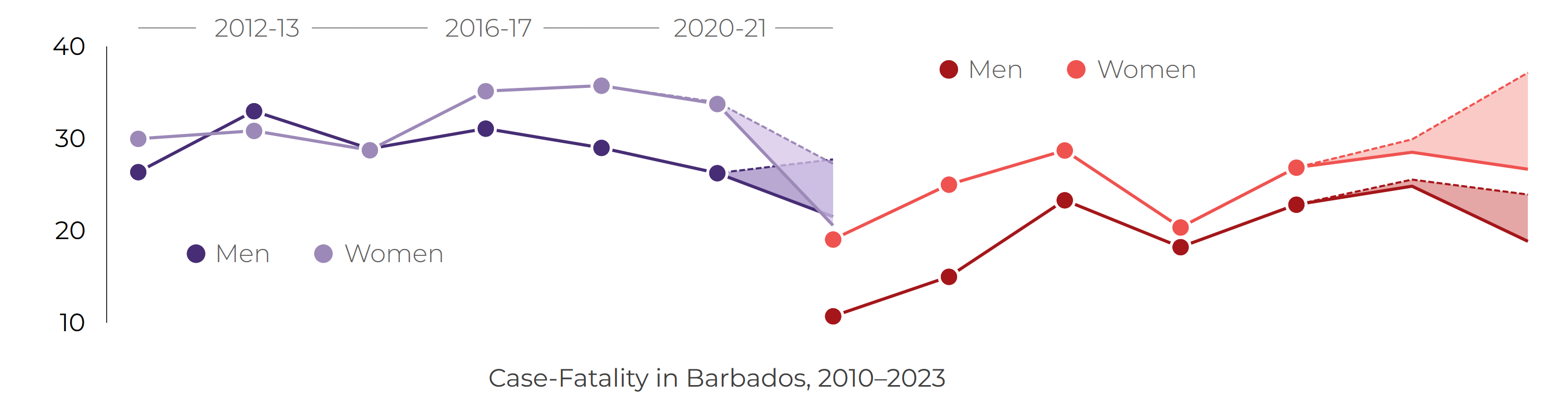
Between 2010 and 2023, in-hospital case fatality after stroke changed little, while case fatality after heart attack fluctuated but showed some evidence of an upward trend. Before age adjustment, women had higher case fatality than men for both conditions. In 2023, 27% of men and 34% of women admitted with cardiovascular disease died before discharge. After adjusting for age, the estimated female rate fell to 30%, suggesting that age explains part — but not all — of this gap. Women admitted with heart attack or stroke were, on average, seven years older than men, and women who died in hospital were similarly older. Seven in ten women, compared with just over half of men, were aged 70 years or older at the time of their event. Even after accounting for this older age profile, women remained more likely to die in hospital than men.

Case-fatality rates show how outcomes differ after patients reach hospital care. The persistence of higher rates among women — only partly explained by their older age profile — highlights the need to understand whether differences in presentation, treatment, severity, comorbidity, or recovery may affect survival.
Download the outputs
The briefing outputs are available in three formats.
| Description | Download | |
|---|---|---|
| PDF briefing for reading or printing | Download PDF briefing | |
| View and use our briefing slide deck | Open briefing slides | |
| Excel workbook with data and metadata worksheets | Download Excel workbook | |
| Full public output package, including DTA, CSV, YML, PNG, workbook, and README files | Download ZIP package |
Suggested Citation
Barbados National Registry. Hospital Cardiovascular Incidence in Barbados: BNR CVD briefing, 2023. Barbados National Chronic Disease Registry, The University of the West Indies. Available at: https://uwi-bnr.github.io/info-hub/surveillance/cvd/briefings/case-case-fatality.html. Accessed: [insert date accessed].