![]()
Hospital Length of Stay in Barbados, 2010-2023
BNR CVD briefing, 2023
Briefing created by the Barbados National Chronic Disease Registry, The University of the West Indies
Group Contacts - Christina Howitt (BNR lead) - Ian Hambleton (analytics) - Updated on 13 Nov 2025
Headline findings
Length of stay turns CVD surveillance data into service-planning intelligence: it shows not only how many patients were admitted, but how long hospital beds were typically occupied.
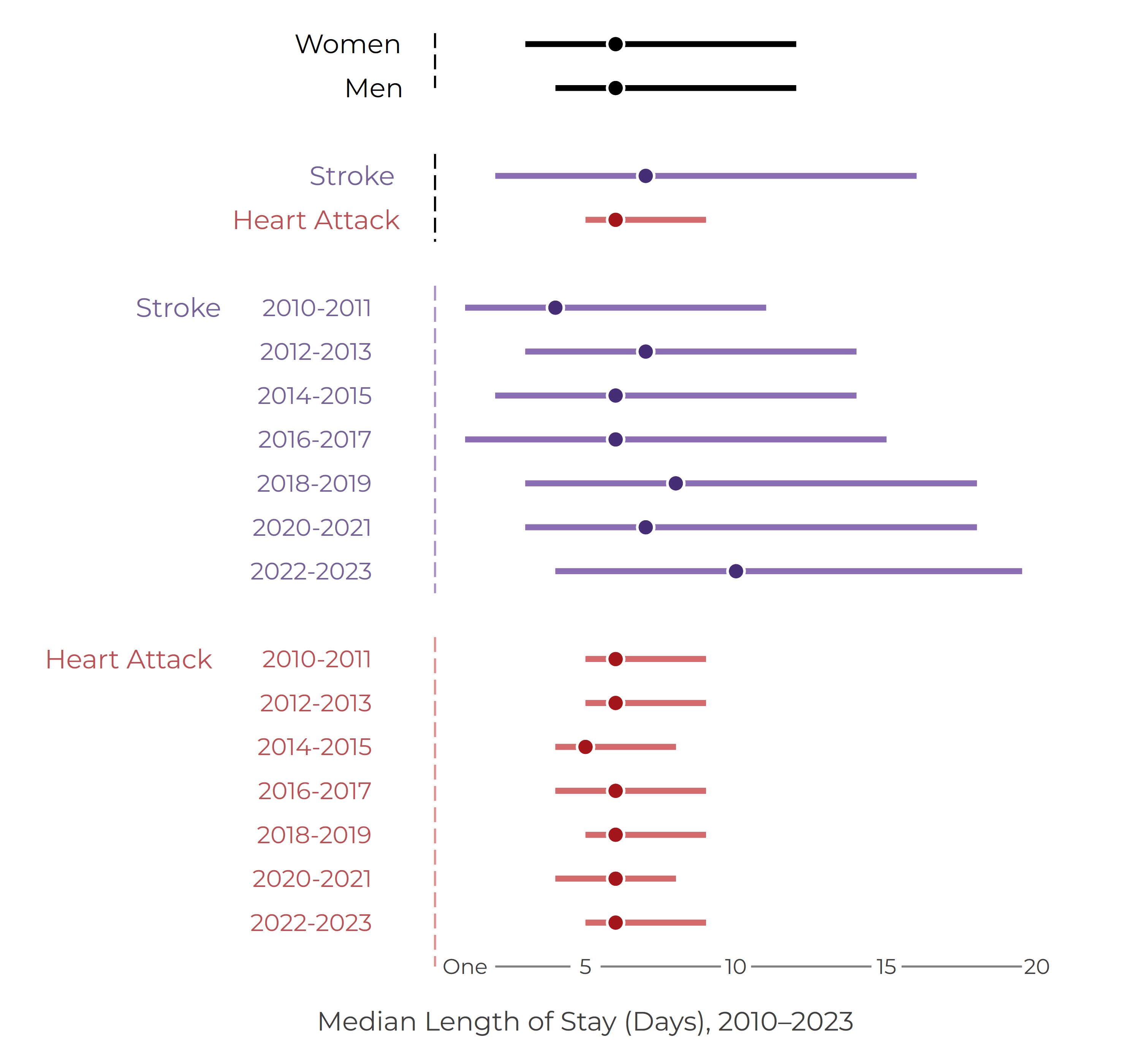
10 days
Stroke, 2022-2023
median hospital stay
6 days
AMI, 2022-2023
median hospital stay
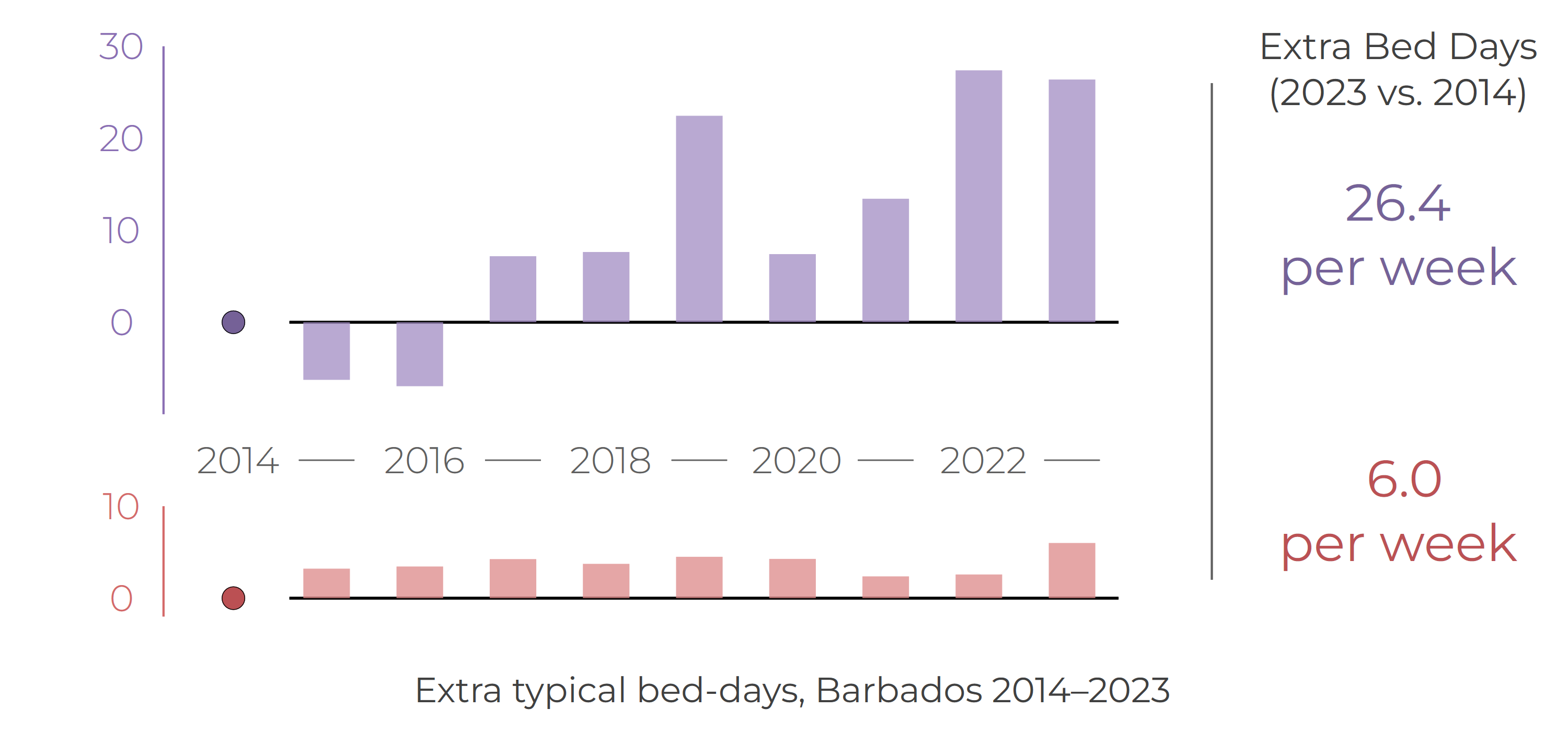
1,372
Stroke, 2023
extra typical bed-days vs 2014
1,684
Stroke + AMI, 2023
extra typical bed-days vs 2014
In 2022-2023, the typical hospital stay after stroke was longer than after AMI. Stroke also accounted for most of the additional typical bed-day pressure in 2023, compared with the 2014 baseline.
Why this matters
Length of stay is a practical hospital burden measure.
- It reflects patient severity and discharge pathways.
- It affects bed occupancy and ward flow.
- It helps translate registry outputs into planning intelligence.
Counts tell us how many patients arrive. Length of stay helps show how long those patients occupy hospital capacity.
What we did
We examined hospital length of stay for CVD events in Barbados from 2010 to 2023.
- We focused on hospital-ascertained stroke and heart attack events.
- We summarised typical stay using the median and interquartile range.
- We estimated extra typical bed-days compared with a 2014 baseline.
Interpretation
Length of stay should be read as both a clinical and operational signal.
It is influenced by case severity, rehabilitation needs, discharge pathways, step-down care, and available community support.
A registry length-of-stay indicator is most useful when interpreted alongside hospital operations knowledge.
What this means
The length-of-stay briefing extends CVD surveillance beyond event counts.
It shows how cardiovascular events translate into hospital resource use and helps identify where registry data can support planning conversations.
Length of stay is not just a clinical outcome. It is also a system-pressure indicator.
Outputs and citation
Tables, figure data, metadata, workbook files, and build records are available in the online briefing.
Barbados National Registry. Hospital length of stay in Barbados, 2010-2023: BNR CVD briefing, 2023. Barbados National Chronic Disease Registry, The University of the West Indies. Accessed: [insert date accessed].