CVD incidence in Barbados, 2010-2023
BNR briefing, 2023
07 Nov 2025
View other formats
Use the slide deck for meetings, teaching, or stakeholder briefings. The PDF version is designed for printing, sharing, and citation.
Why this matters
Heart attacks and strokes remain the leading causes of serious illness and death in Barbados. Tracking how often these events occur in hospital helps us see whether prevention and treatment efforts are working. Measuring rates—not just counts—lets us compare fairly over time, even as the population grows and ages. This approach helps us tell whether apparent increases reflect real changes in cardiovascular risk, or simply demographic shifts. By following these patterns, we can see where progress is being made and where renewed attention is needed.
What we did
We looked at all heart attack and stroke events that were treated in hospital or recorded as the main cause of death. Using Barbados population estimates, we calculated how many people per 100,000 experienced these conditions each year. We then adjusted rates for age so that figures from different years, or between men and women, could be compared on equal terms. These analyses give a clear, evidence-based picture of how cardiovascular disease is affecting Barbadians over time.
This briefing focuses on three questions:
How has incidence changed?
How have age-standardised stroke and heart attack incidence rates change in Barbados between 2010 and 2023?
What is missed by hospital data alone?
How much do incidence estimates change when death-certificate-only events are included alongside hospital-registered events?
Where are rates highest?
How do incidence patterns differ by event type, sex, and time period?
Headline findings
Age-standardised incidence rates per 100,000 population, 2023.
Women
Stroke
141
per 100,000
Men
Stroke
198
per 100,000
Women
Heart attack
90
per 100,000
Men
Heart attack
145
per 100,000
CVD Incidence
Heart attacks leave more deaths unseen than Strokes
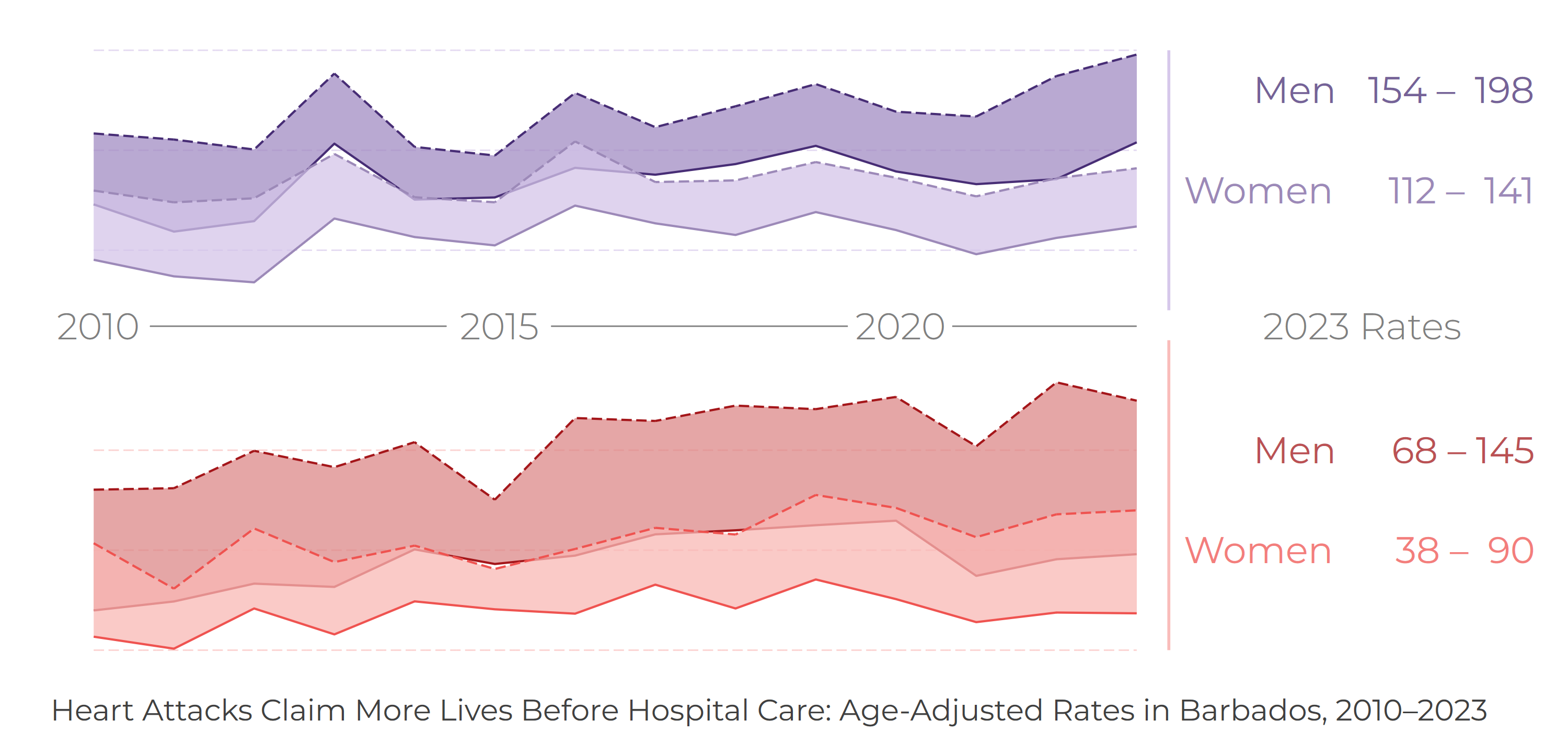
The figure above tracks rates of heart attack and stroke in Barbados between 2010 and 2023 for men and women. Each solid line shows the number of hospital-treated events per 100,000 people, while the dotted line adds in deaths identified only through death certificates. The shaded areas between the lines highlight the “hidden” events that occur outside the hospital system.
Across all years, men had higher rates than women for both conditions, reflecting their greater cardiovascular risk. But the size of the gap between the solid and dotted lines tells an additional story. That gap—representing deaths that never reached hospital—is consistently wider for heart attacks than for strokes, and wider for men than for women. On average, including these out-of-hospital deaths raised rates by about 77 per 100,000 for men with heart attacks, 51 for women, 44 for men with stroke, and 29 for women.
These findings suggest that heart attacks are more likely than strokes to be fatal before hospital care is reached, especially among men. This pattern likely reflects differences in how quickly symptoms are recognised and treated. Fewer lives will be lost through faster public response, improved awareness, and rapid treatment pathways—particularly for men.
Hospital rates show a decade of rising strokes and a persistent excess among men
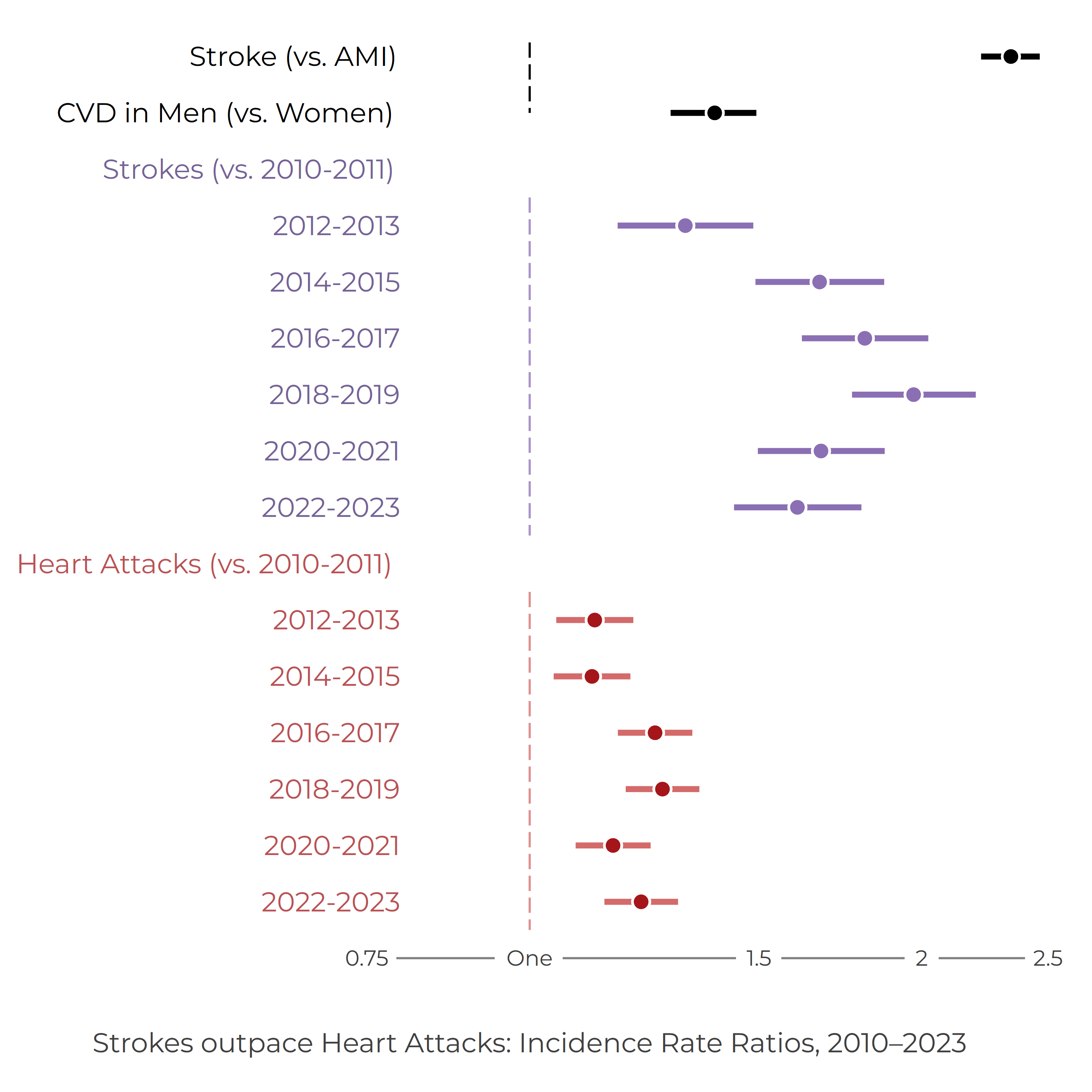
The figure above summarises how hospital-based rates of stroke and heart attack have changed in Barbados since 2010. Each bar shows a rate ratio comparing one group or time period with another, with values above one indicating higher rates. Because almost all serious cardiovascular events are treated at the island’s single public tertiary hospital, these figures provide a reliable picture of national trends, even though they reflect hospital events only.
Across the full period, strokes occurred at more than twice the rate of heart attacks (rate ratio 2.34; 95% CI 2.27–2.41), confirming stroke’s heavier burden in Barbados. Men consistently experienced higher cardiovascular event rates than women (1.39; 1.33–1.44), a difference that has changed little over time and continues to signal the need for greater focus on men’s prevention and early treatment.
Both conditions showed clear increases over the past decade. Stroke rates rose most sharply, almost doubling between 2010–2011 and 2018–2019 (1.97; 1.77–2.20), before easing slightly in recent years to about 60 percent above baseline (1.61; 1.43–1.80 in 2022–2023). For heart attacks, increases were smaller but still evident—around 20–25 percent higher than at the start of the decade (1.22; 1.14–1.30 in 2022–2023). Some of the fluctuations after 2020 likely reflect changes in healthcare access and hospital use during the COVID-19 pandemic, when fewer people sought emergency care for milder events.
Strengthening hypertension and diabetes control, improving recognition of stroke and heart-attack symptoms, and sustaining rapid emergency response remain critical steps to reducing avoidable deaths and long-term disability.
Download the outputs
The briefing outputs are available in three formats.
| Description | Download | |
|---|---|---|
| PDF briefing for reading or printing | Download PDF briefing | |
| View and use our briefing slide deck | Open briefing slides | |
| Excel workbook with data and metadata worksheets | Download Excel workbook | |
| Full public output package, including DTA, CSV, YML, PNG, workbook, and README files | Download ZIP package |
Suggested Citation
Barbados National Registry. Hospital Cardiovascular Incidence in Barbados: BNR CVD briefing, 2023. Barbados National Chronic Disease Registry, The University of the West Indies. Available at: https://uwi-bnr.github.io/info-hub/surveillance/cvd/briefings/case-incidence.html. Accessed: [insert date accessed].